
I recently traveled throughout the UK, Ireland, and France on a family trip kicking off my 50th birthday celebrations. And from past visits to Ireland, I knew exactly where I wanted to stop: the Blarney Woolen Mills in Cork.
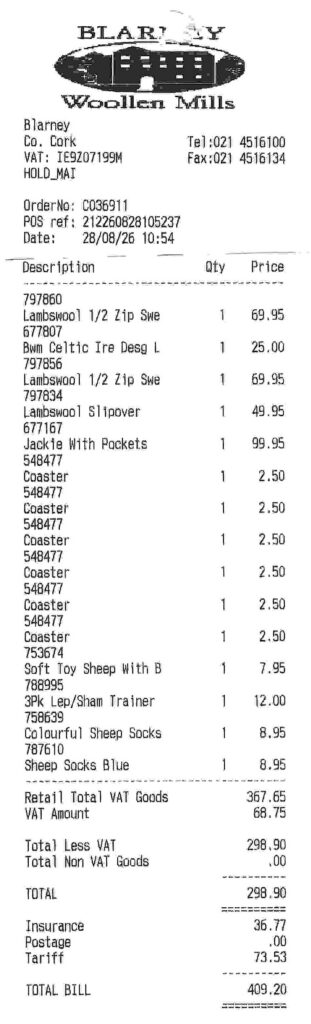
I stocked up on Irish sweaters and souvenirs and took advantage of Blarney’s offer to ship larger purchases home. My €367.65 shopping spree became €298.90 after €68.75 in Irish VAT was removed.
Then came the surprise on my receipt: “Tariff: €73.53”
Ireland had just taken €68.75 in taxes off my purchases. My own government put €73.53 back on.
Donald Trump has repeatedly insisted that Americans don’t bear the cost of his tariffs. “A tariff is a tax on a foreign country,” he said during the 2024 campaign. “A lot of people like to say it’s a tax on us. No, no, no.”
Before August 2025, the U.S. generally allowed imported packages worth $800 or less to enter the U.S. duty-free under the federal de minimis exemption. Thanks to a Trump executive order, that exemption was suspended and now packages like my Irish sweaters and souvenirs fare subject to applicable duties when being sent home to the U.S.
The end of the de minimis exemption also means low-value shipments can now be exposed to longstanding U.S. duties on products such as apparel. While some were invalidated by the courts, new Section 301 tariffs were put in place by the Trump administration in July, generally bringing products with lower existing tariff rates up to a combined 10 percent rate.
Just a couple of weeks after my tariff-filled Irish trip, President Trump himself travelled to Ireland to attend the Irish Open golf tournament being held at his Doonbeg golf course. While there – and to the cheers of many fans – he announced that he would give into the pressure being exerted by the champion golfer Shane Lowry and others and planned to remove the 10 percent U.S. tariff on Irish whiskey.
Removing the tariff should make Irish whiskey less expensive for Americans. But why should that logic stop at the liquor cabinet?
Why eliminate the tariff on a bottle of Jameson an American buys at home, while maintaining policies that make the Irish sweater an American tourist buys in Cork more expensive?
A tariff is still a tax on an import transaction. Somebody bears its cost.
Despite President Trump’s insistence that foreign countries pay the tariffs, considerable evidence shows that Americans are bearing much of the cost – consumers through higher prices and U.S. businesses through higher import costs and squeezed margins.
Writing in the Journal of Economic Perspectives, economists Gita Gopinath and Brent Neiman found that 92 percent of the Trump 2025 tariffs were passed through to U.S. import prices, meaning American importers bore most of the immediate cost. The Yale University Budget Lab estimates that household costs due to tariffs at about $1,100 annually under the current law.
An analysis earlier this year from Harvard Business School’s Pricing Lab, which tracks hundreds of thousands of products at major U.S. retailers, similarly found that consumers absorbed about 43 percent of the tariff burden during the first seven months studied, while American companies absorbed the rest. Either way, Americans are paying the bill.
Tony Spring, CEO of Macy’s, recently told the Wall Street Journal that “the furniture business was impacted by tariffs more than we anticipated,” noting that “something that was $2,900 became $3,400.” After receiving a tariff refund, Macy’s said that it would use some of the money to lower furniture prices.
President Trump was right to give Irish whiskey a reprieve. Americans shouldn’t have to pay more to the U.S. government for a bottle from Dublin simply because it crossed an ocean.
But the same principle ought to apply to the sweaters, clothing and souvenirs Americans bring home – or have shipped home – from places like the Blarney Woolen Mills.
My receipt couldn’t make the point any clearer. Ireland removed €68.75 from my purchases. Then my own government put €73.53 back on.
If lower tariffs are good enough for Irish whiskey, they’re good enough for the rest of the Irish shopping bag.
Tim Anaya is the Pacific Research Institute’s vice president of marketing and communications and co-author of The California Left Coast Survivor’s Guide.