
The microwave oven, a staple of American kitchens since the 1970s, was another of those indispensable technologies that was invented by accident, joining Post-It notes, X-rays, Penicillin, superglue, and the mullet haircut. (Okay, I made that last one up, but it is hard to believe some rando hair stylist created it deliberately.) How the kitchen appliance industry persuaded Americans, bamboozled by propaganda about the infinitessimally small risks from distant nuclear power plants, to bombard their food with microwave radiation from two feet away is one of those phenomena that deserve prominent location in the National Museum of Cognitive Dissonance.
Although the technology, initially called the “cavity magnetron,” was invented in the 1940s, it wasn’t successfully mass-marketed to American consumers until the 1970s. You might think the initial name—”cavity magnetron”—had something to do with it, since that sounds more like a medical device you’d expect to find in a proctologist’s office than a kitchen tool. But the real reason was the price. The earliest models for home use appeared in the 1960s, but at a price tag of about $500, which adjusted for inflation would be about $5,300 today. That’s too steep just to boil water or defrost some chicken nuggets. And they tended to be the size of a TV cabinet (remember those?), taking up a ton of counter space.
But as happens with most new technologies, the cost fell rapidly such that by the late 1970s the nominal price was under $500, which with 1970s inflation meant it cost a lot less than a decade before. Still, according to household survey data only 20 percent of American households had one by 1980, and only 25 percent by 1985. As prices fell further, 90 percent of American homes had one by 1997.
You can pick up an 800-watt countertop microwave today for $100 if you want to. But better hurry, because they have suddenly become obsolete, and will likely gather dust on your counter.
Behold the newest, must-have kitchen gadget: the air fryer. Sales of air fryers worldwide have grown tenfold in the last six years, with several forecasts calling for total sales to triple over the next decade. There are estimates that 60 percent of American households already have one, with the number expected to top 70 percent soon. This is a much faster penetration than microwave ovens; only smart phones have seen adoption this rapid.
I love my air fryer. a Ninja double-stack ($249 on Amazon). So much so that I now routinely ask people on the street, “Have you accepted the air fryer as your Lord and Savior?” Well okay, I don’t, but my air fryer threatens to displace my oven and grill, which I would have said is un-American just a year ago. At least for chicken, from individual parts to a whole bird, it is now a coin toss between whether to cook chicken on the charcoal grill or the air fryer.
The amazing thing is that unlike the microwave, the air fryer isn’t a new technology at all.
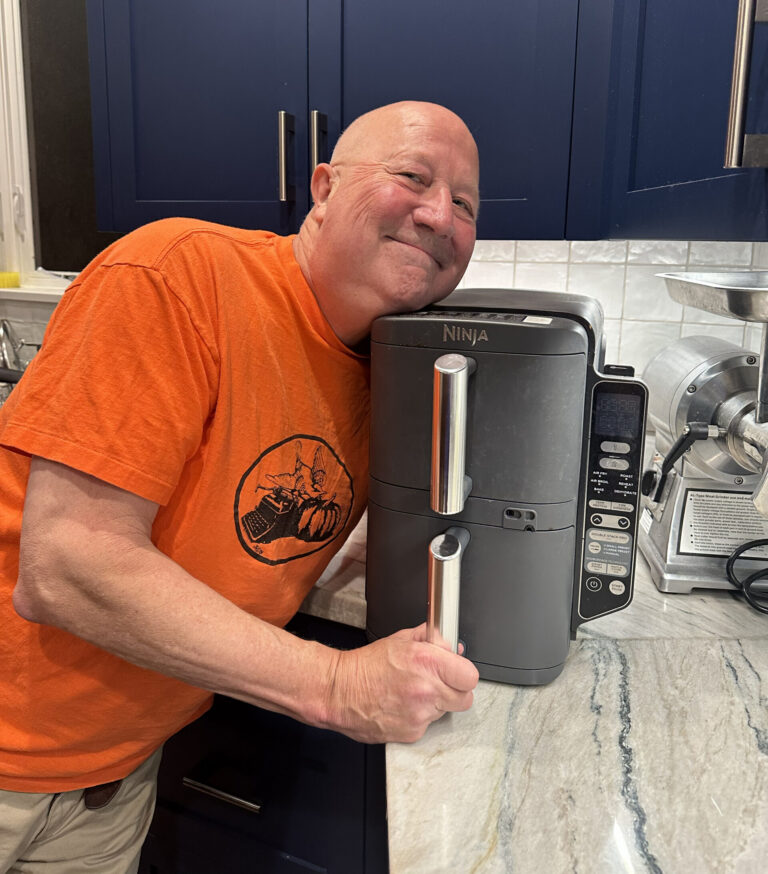
In fact, if you have an up-to-date kitchen oven, you likely already have one but don’t know it. The air fryer is simply a compact, counter-top convection device. But most people don’t know how to use the convection settings on their built-in ovens, and the owner’s manuals are not especially helpful.
This is where the genius of Big Air Fry comes in. The rise of air fryers is a triumph of marketing over technology, or, to borrow Steve Jobs’s famous phrase, giving consumers something new they didn’t know they wanted yet. Air fryers are designed to be highly versatile and user-friendly, and typically come with owner’s manuals with recipes and guides to using their various modes (air fry, thaw, reheat, etc), temperature settings, and timers. They generally complete the cooking cycle in half the time of an oven or grill, a function of the high-speed fan accelerating the convection. And because they use old-fashioned heat rather than radiation, air fryers reheat leftovers much better than microwaves. No longer must you put up with flaccid crusts of pizza reheated in a microwave, chicken with rubbery skin, or potatoes with the favor somehow leached out.
While some air fryer recipes call for a small amount of oil (usually sprayed lightly), it is possible to cook most items without cooking oil. I’ve not joined the anti-seed oil bandwagon, though I do now see that I misunderstood Robert F. Kennedy Jr. for years when he attacked “big oil,” thinking he meant ExxonMobil, when he really meant was “big seed oil,” like Archer-Daniels-Midland. In any case, for people who like to avoid anything fried in oil, whether chicken wings or vegetables, the air fryer is the technology for you. I frequently make tater tots and french fries with little or no oil.
My favorite meal to make on short notice is chicken legs (though fried chicken wings or thighs work well too). Season legs with any combination of spices you like, but add a light dusting of baking powder and set aside in your fridge for at least an hour. (The baking powder makes the skin crispy and yields a result comparable to deep-fried chicken.) Air fry for about 12 minutes at 325 degrees, then flip the pieces over and bake for another 12 minutes or so with the temperature turned up to 400 degrees.
Finally, air fryers, unlike ovens—convection or not, are quick and easy to clean. The point is, microwaves are obsolete. My microwave has been broken for several months now because of some hard-to-get part. I haven’t missed it.
Steven Hayward is a Senior Fellow at the Pacific Research Institute.